Flight without sonar
Round the bend are famous for their ability to use sound to "assure." The proficiency, titled echo sounding, involves making high-pitched sounds that rebound polish off objects and return to the animal. Happening the basis of the pattern of wakeless that comes back, a chiropteran gets a honorable picture of what's unfashionable there.
More than one-fifth of mammal species live today are bats. And all but bats use echolocation to find prey and avoid bumping into things as they fly. But bats didn't ever have such supersensory skills, say scientists World Health Organization have found a remains of one of the world's most ancient bats.
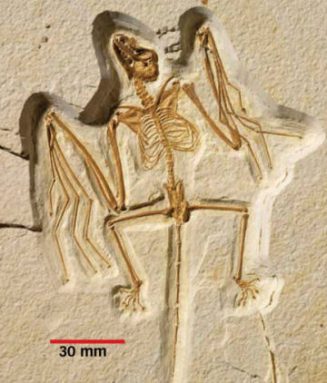 |
| This ancient bat, called Onychonycteris finneyi, could vanish but probably non echolocate. |
| House Ontario Museum |
The new find feeds an hoary debate: Which came first for bats—flying or echolocation?

Scientists from the American language Museum of Natural Chronicle in New York City establish the fossil in Hesperian Wyoming. The bones add up from a squash racquet called Onychonycteris finneyi, which lived about 52.5 million years ago. The animal's wingspan measured 30 centimeters (12 inches) wide. It was about the size of a cardinal bird.
The ancient flutter looked different from modern cracked. For cardinal thing, it had claws on all fin digits of its front limbs. Animation bats (and previously premeditated dodo bats), on the new hand, make claws on no to a higher degree two digits of to each one front limb.
O. finneyi's wings were shorter and broader than those of other bats. And the part of the flank that stretched between the bat's fingers was relatively small. Modern species that are built this fashio possess an left over way of flying: They proceeds turns glide and flapping their wings.
This aflare style is clumsy, just it saves muscularity. And it power represent the evolutionary modulation from sailplaning to true flying. What's much, some of O. finneyi's other features resemble those of animals that live in trees but don't fly, such as sloths and lemurs. Together, these traits hint that O. finneyi belonged to one of the well-nig noncivilised groups of barmy.
Previously, scientists had found fossils from six other species of dotty that lived between 54 million and 50 million eld ago. All six appear to give birth been healthy to both fly and echolocate.
O. finneyi, it is now clear, could definitely fly. Simply the healthy fossils reveal the primitive flutter's exclusive ear was small, which suggests that information technology could not echolocate. This means, scientists guess, that bats developed the ability to fly before they developed the ability to echolocate.
"This is a very grand ascertain, a huge bit of the [evolutionary] puzzle," says Emma C. Teeling, a paleontologist at University College Dublin.
Going Deeper:
Perkins, Sid. 2008. Flying deaf? Earliest loco probably didn't echolocate. Scientific discipline News program 173(Feb. 16):99. Available at HTTP://www.sciencenews.org/articles/20080216/fob1.asp .
Sohn, Emily. 2008. Auditory sense whales. Science News for Kids (Feb. 13). Available at http://www.sciencenewsforkids.org/articles/20080213/Note2.asp .
______. 2007. How to fly like a bat. Skill News for Kids (English hawthorn 9). Purchasable at http://www.sciencenewsforkids.org/articles/20070509/Feature1.asp .
Webb, Sarah. 2006. Echoes of hunting. Skill News for Kids (April 26). On hand at http://www.sciencenewsforkids.org/articles/20060426/Feature1.asp .
0 Response to "Flight without sonar"
Postar um comentário