What Is Considered the Most Basic of All Visual Arts Most Common Support Is Monochromatic Paper?

Monochromatic painting has been an important component of avant-garde visual art throughout the 20th century and into the 21st century. Painters have created the exploration of ane colour, examining values irresolute across a surface, texture, and nuance, expressing a wide variety of emotions, intentions, and meanings in many different forms.[1] From geometric precision to expressionism, the monochrome has proved to be a durable idiom in Contemporary art.[2]
Origins [edit]
Monochrome painting was initiated at the get-go Incoherent arts' exhibition in 1882 in Paris, with a blackness painting by poet Paul Bilhaud entitled Gainsay de Nègres dans un tunnel (Negroes fight in a tunnel). (Although Bilhaud was not the first to create an all-blackness artwork: for instance, Robert Fludd published an image of Darkness in his 1617 book on the origin and structure of the cosmos; and Bertall published his black Vue de La Hogue (effet de nuit) in 1843.) In the subsequent exhibitions of the Incoherent arts (also in the 1880s) the writer Alphonse Allais proposed other monochrome paintings, such as "Première communion de jeunes filles chlorotiques par un temps de neige" ("Showtime communion of anaemic immature girls in the snow", white), or "Récolte de la tomate par des cardinaux apoplectiques au bord de la Mer Rouge" ("Tomato harvesting by apoplectic cardinals on the shore of the Cherry Ocean", scarlet). Allais published his Album primo-avrilesque in 1897, a monograph with seven monochrome artworks. All the same, this kind of activity bears more similarity to 20th century Dada, or Neo-Dada, and especially the works of the Fluxus group of the 1960s, than to 20th century monochrome painting since Malevich.
Jean Metzinger, following the Succès de scandale created from the Cubist showing at the 1911 Salon des Indépendants, in an interview with Cyril Berger published in Paris-Periodical 29 May 1911, stated:
Nosotros cubists accept simply done our duty by creating a new rhythm for the do good of humanity. Others will come up afterward us who will do the same. What volition they observe? That is the tremendous surreptitious of the future. Who knows if someday, a great painter, looking with scorn on the often brutal game of supposed colorists and taking the vii colors back to the primordial white unity that encompasses them all, volition not exhibit completely white canvases, with nothing, admittedly zip on them. (Jean Metzinger, 29 May 1911)[3] [4]
Metzinger's (and so) audacious prediction that artists would take abstraction to its logical conclusion by vacating representational subject matter entirely and returning to what Metzinger calls the "primordial white unity", a "completely white canvass" would be realized two years later. The writer of a satirical manifesto entitled Manifeste de l'école amorphiste, published in Les Hommes du Jour (iii May 1913), may take had Metzinger'due south vision in mind when the writer justified amorphism's blank canvases by claiming 'calorie-free is plenty for usa'.[iv] [5] [half dozen] With perspective, writes art historian Jeffery S. Weiss, "Vers Amorphisme may be gibberish, only it was as well enough of a foundational language to anticipate the extreme reductivist implications of non-objectivity".[seven]
In a broad and general sense, one finds European roots of minimalism in the geometric abstractions of painters associated with the Bauhaus, in the works of Kazimir Malevich, Piet Mondrian and other artists associated with the De Stijl motion, and the Russian Constructivist motility, and in the work of the Romanian sculptor Constantin Brâncuși.[viii] [nine] Minimal art is also inspired in part past the paintings of Barnett Newman, Advertisement Reinhardt, Josef Albers, and the works of artists as diverse as Pablo Picasso, Marcel Duchamp, Giorgio Morandi, and others. Minimalism was also a reaction confronting the painterly subjectivity of Abstract Expressionism that had been dominant in the New York School during the 1940s and 1950s.[x]
The wide range of possibilities (including impossibility) of interpretation of monochrome paintings is arguably why the monochrome is then engaging to so many artists, critics, and writers. Although the monochrome has never get ascendant and few artists have committed themselves exclusively to it, it has never gone away. It reappears as though a spectre haunting high modernism, or equally a symbol of information technology, appearing during times of aesthetic and sociopolitical upheavals.[11]
Suprematism and Constructivism [edit]
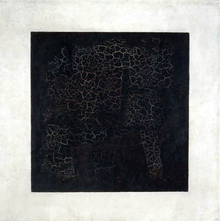
Monochrome painting as it is usually understood today began in Moscow, with Suprematist Limerick: White on White [13] of 1918 by Suprematist artist Kazimir Malevich. This was a variation on or sequel to his 1915 piece of work Black Square on a White Field, a very important work in its own right to 20th century geometric brainchild.
In 1921, Constructivist creative person Alexander Rodchenko exhibited Pure Cherry-red Color, Pure Blue Color, and Pure Yellow Color: 3 paintings together, each a monochrome of one of the three primary colors. He intended this work to represent the "death of painting."[xiv] While Rodchenko intended his monochrome to be a dismantling of the typical assumptions of painting, Malevich saw his work equally a concentration on them, a kind of meditation on fine art's essence ("pure feeling").
These ii approaches articulated very early on in its history this kind of piece of work's nigh paradoxical dynamic: that one tin can read a monochrome either as a flat surface (material entity or "painting equally object") which represents nothing but itself, and therefore representing an ending in the development of illusionism in painting (i.e. Rodchenko); or as a depiction of multidimensional (space) space, a fulfillment of illusionistic painting, representing a new development—a new outset—in Western painting's history (Malevich). Additionally, many have pointed out that it may be hard to deduce the artist's intentions from the painting itself, without referring to the artist's annotate.
Artists [edit]
New York [edit]
Abstract Expressionists [edit]
- Milton Resnick had a long career as an Abstruse Expressionist painter. Initially, during the 1940s, he explored the so-current fashion of Action Painting. His later work, from the 1950s through the 1970s is often characterized as Abstruse Impressionist—largely because he constructed his allover compositions with multiple, repetitive, and close-valued brushstrokes, in the manner of Claude Monet in the famous Waterlilies series. During the final two and a half decades of his painting career Resnick'southward paintings became monochromatic,[15] albeit with thickly brushed and layered surfaces.
- Advert Reinhardt was an Abstract Expressionist artist notable for painting nearly "pure" monochromes over a considerable span of fourth dimension (roughly from 1952 to his decease in 1967), in red or blue, and lastly and well-nigh (in)famously, in black. Similar the Johns works mentioned beneath, Reinhardt's black paintings[16] independent faint indications of geometrical shape, but the actual delineations are not readily visible until the viewer spends time with the work. This tends to encourage a country of contemplative meditation in the viewer, and to create uncertainty near perception; in terms of Frank Stella's famous quote, yous may question whether "what you see" is actually what you are seeing.[17]
- Richard Pousette-Sprint created several distinct series of paintings during his long career equally an Abstract Expressionist painter, his monochromatic serial called Presences [eighteen] spanning the belatedly 1950s through the early 1990s, was among his most powerful.
Colour field [edit]
Beginning in the 1950s and 1960s, several Abstract Expressionist / color field artists (notably: Barnett Newman, Mark Rothko, Robert Motherwell, Adolph Gottlieb, Theodoros Stamos, Sam Francis, Ludwig Sander, Clyfford Still, Jules Olitski, and others) explored motifs that seemed to imply monochrome, employing wide, flat fields of colour in large scale pictures which proved highly influential to newer styles, such as Post-Painterly Abstraction, Lyrical Brainchild, and Minimalism.
One of Barnett Newman's almost monochrome paintings generated outrage and widespread ridicule (and word) in Canada when the National Gallery purchased Vocalisation of Burn down for a big sum of money, in the 1980s. Some other of Barnett Newman's very thin (though technically non monochrome) geometric abstractions was slashed with a knife past an enraged viewer in the 1980s at the Stedelijk Museum in Amsterdam.
Lyrical Abstraction [edit]
Lyrical Abstractionist painters such as Ronald Davis, Larry Poons, Walter Darby Bannard, Dan Christensen, Larry Zox, Ronnie Landfield, Ralph Humphrey, David Budd, David R. Prentice, David Diao, David Novros, Jake Berthot, and others also explored and worked on series of shaped and rectangular canvases that approached the monochrome—with variations especially during the 1960s and 1970s.
Shaped canvas [edit]
Since the 1960s artists every bit various as Frank Stella, Ellsworth Kelly, Ronald Davis, David Novros, Paul Mogensen, Patricia Johanson and others made monochrome paintings on various shaped canvases. While some of their monochromatic works related to minimalism none of the in a higher place were minimalists.
Neo-Dada [edit]
- Robert Rauschenberg: "A canvas is never empty".[19] In the early 1950s, became known for white, and so blackness, and eventually red monochrome canvases. In the White Paintings [20] (1951) series, Rauschenberg applied everyday house paint with paint rollers to achieve smooth "blank" surfaces. White panels were exhibited alone or in modular groupings. The Black Paintings (1951–1953) incorporated texture nether the painted surface past mode of collaged newspaper that sometimes indicates a grid-similar structure. The Ruby Paintings (1953–54) incorporate still more materials such as wood and material under the heavily worked painted surface, and seem to foreshadow Rauschenberg's evolution of assemblage in his "Combine Paintings" too as his stated intention to act in "the gap" between "Art" and "Life".
- The white canvases became associated with the piece of work iv'33" by the composer John Cage, which consisted of three movements of silence, and was inspired at to the lowest degree in part by Cage's report of Zen Buddhism. In both works attention is drawn to elements of listening / viewing which prevarication outside the artist's control: e.g. the sounds of the concert surroundings, or the play of shadows and dust particles accumulating on the 'bare' canvas surfaces ("landing strips" – Cage).
- In a related piece of work, his Erased de Kooning Drawing of 1953, Rauschenberg erased a drawing past abstract expressionist artist Willem de Kooning. Perhaps surprisingly, De Kooning was sympathetic to Rauschenberg'due south aims and implicitly endorsed this experiment by providing the younger creative person with one of his ain drawings which was very densely worked, taking 2 months and many erasers for Rauschenberg to (incompletely) erase.
- Jasper Johns was a friend of Rauschenberg, and both were often categorized equally Neo-Dadaist, pointing to their rejection of the Abstruse Expressionist aesthetic which was dominant in the 1950s. Johns painted a number of works such as White Flag, Green Target,[21] and Tango, in which there is only a slight indication of an prototype, resembling the White Square on a White Field of Malevich in technique.
- These works often show more evidence of brushwork than is typically associated with monochrome painting. Many other works likewise approach monochrome, similar the melancholic "grey" works of the early 1960s, only with real objects ("assemblage") or text added.
Minimalists [edit]
- Ellsworth Kelly spent a lot of time in both Paris and New York. Not strictly a minimalist, he has made a number of monochrome paintings on shaped canvases and unmarried color rectangular panels. His abstractions[22] were "abstracted" from nature. His interest in nature extends so far that he has made a series of plant lithographs[23] in an impressive and sincerely realistic fashion.
- Mino Argento monotones, white on white paintings were variations on the gridded, rectangle on rectangle themes, just were enlivened with differences in rhythm and conception. I composition included grayed grids and vertical rectagles in several, more than opaque whites, clustered centrally.[24]
- Agnes Martin whose works of the 1950s and 1960s are serene meditations on "perfection", and hence "beauty", are typically white, fair or stake grayness canvases with faint evidence of pencil dragged in lines or grids across the painted surface.[25]
- Robert Ryman in works such as Ledger (1982)[26] bring the word "synthetic" to listen, with attention drawn to supports, framing, and the creative person's signature as of import elements of works which are usually white, or fair, and in square format. Abstract Expressionist brushwork is used equally formal textile in these minimalist constructions. Ryman exhibits a tour de forcefulness of variation on a deliberately limited theme.

- Brice Marden in his earliest mature works explored a reductive strategy which seemed similar to that of Jasper Johns's and Ellsworth Kelly's contemporaneous works, yet more formalist: paintings such as Return 1 [27] consist of subtly greyness fields painted in encaustic (wax-medium) with a narrow strip forth the bottom of the canvas where Marden left bare bear witness of process (i.e., drips and spatters of paint). During the late 1980s Brice Marden, who held a spiritual/emotional view of abstraction, began a more multi-colored and calligraphic class of abstract painting.
- Frank Stella echoed composer Igor Stravinsky's famous assertion that "music is powerless to limited anything simply itself" when he said "What you see is what you come across", a remark he later qualified by saying his early paintings were influenced to a degree past the writing of Samuel Beckett (run across above). In his work he was attempting to minimize any inference of "spiritual" or even "emotional" response on the function of the viewer, and this is perhaps most striking in his pinstripe[28] starting time in the belatedly 1950s, where the pinstripes are articulated by unpainted canvas. Afterwards, Stella abased not but monochrome, only also somewhen geometric painting.
- John McCracken is characteristically Minimalist in that his "objects" aren't adequately categorized as "painting" or "sculpture". Famous since 1965 for "slabs, columns, planks ... Neutral forms", his meticulously finished, polished monochrome objects[29] are ofttimes simply leaned upwards against gallery walls, in what some critics depict as a casual "West Declension-lean". Although he draws from techniques characteristic of surfboard industry, his works are personally and meticulously handcrafted, unlike those of John M. Miller and other more recent artists, which are typically manufactory-fabricated according to the creative person's specifications.
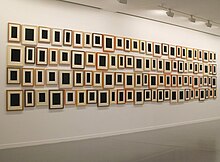
Allan McCollum, Drove of 1 Hundred Plaster Surrogates, 1982/1990, Enamel on cast Hydrostone. Collection: Museum van Hedendaagse Kunst Antwerp, Belgium
- Allan McCollum determined in the mid-1970s that the social forces that give paintings meaning may exist better understood if the "painting" itself could be reduced to a generic class—a painting that could read equally a "sign" for a painting", which could function of a "placeholder", or a kind of "prop". In the 1970s and early on 80s he painted what he called Surrogate Paintings, and ultimately began casting them in plaster, frame and all. These hundreds of objects that looked like framed, matted, fields of painted black, worked equally neutral, "generic signs" that might inspire the viewer to think near the social expectations that constructed the "idea" of a painting, more than the actual painting itself. By reducing paintings to mere signs of themselves, McCollum turned the gallery and the museum setting into a kind of theater, highlighting the drama of presenting, displaying, buying and selling, exchanging, photographing, assessing, criticizing, choosing, and writing about the works; the object-paintings at the center of the action were purposely rendered moot, in order to plow ane's attending to the supplementary devices and social practices that, in the end, bequeath the value on the work. Paradoxically, as time went by, these neutral objects became valuable in themselves, equally symbols of an anthropological fashion of looking at fine art.
- Anne Truitt was an American artist of the mid-20th century; she is associated with both minimalism and Color Field artists like Morris Louis and Kenneth Noland. Primarily thought of as a minimalist sculptor, and as a colorist who painted her sculpture, throughout her career Truitt produced several series of Monochromatic paintings.
- She made what is considered her nigh important work in the early 1960s anticipating in many respects the work of minimalists like Donald Judd and Ellsworth Kelly. She was unlike the minimalists is some significant ways. She named, for instance, many of her works after places and events that were important to her—a do suggesting a narrative beyond and yet somehow contained by the sculpture.
- The sculpture that fabricated her significant to the development of Minimalism were aggressively plain and painted structures, ofttimes large. The recessional platform under her sculpture raised them merely enough off the ground that they appeared to float on a sparse line of shadow. The purlieus between sculpture and basis, between gravity and verticality, was made illusory. This formal ambivalence is mirrored by her insistence that color itself, contained a psychological vibration which when purified, every bit it is on a work of art, isolates the issue information technology refers to as a affair rather than a feeling. The event becomes a work of art, a visual awareness delivered by colour.
Europe [edit]
- Lucio Fontana started from 1949 the so-chosen Spatial Concept or slash series, consisting in holes or slashes on the surface of monochrome paintings, drawing a sign of what he named "an art for the Space Historic period" (Concetto spaziale (50-B.1), 1950, MNAM, Paris).
Monochrome works: The Blue Epoch [edit]
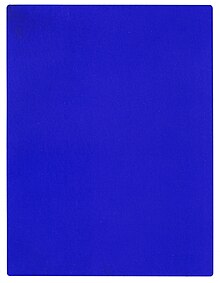
- Yves Klein: although Klein had painted monochromes as early on every bit 1949, and held the first private exhibition of this work in 1950, his first public showing was the publication of the creative person's book Yves: Peintures in November 1954. Parodying a traditional catalogue, the volume featured a series of intense monochromes linked to various cities he had lived in during the previous years. Yves: Peintures anticipated his first two shows of oil paintings, at the Club des Solitaires, Paris, October 1955 and Yves: Proposition monochromes at Gallery Colette Allendy, February 1956. These shows, displaying orangish, yellow, ruby-red, pinkish and blue monochromes, deeply disappointed Klein, as people went from painting to painting, linking them together every bit a sort of mosaic.
From the reactions of the audience, [Klein] realized that...viewers thought his diverse, uniformly colored canvases amounted to a new kind of bright, abstract interior decoration. Shocked at this misunderstanding, Klein knew a further and decisive step in the direction of monochrome fine art would have to be taken...From that time onwards he would concentrate on one single, principal colour alone: blueish.
—Hannah Weitemeier[xxx]
The next exhibition, Proposte Monochrome, Epoca Blu (Proposition Monochrome; Blueish Epoch) at the Gallery Apollinaire, Milan, (January 1957), featured xi identical bluish canvases, using ultramarine pigment suspended in a synthetic resin Rhodopas. Discovered with the assistance of Edouard Adam, a Parisian paint dealer, the effect was to retain the luminescence of the pigment which tended to become deadening when suspended in linseed oil. Klein later patented this recipe to maintain the "authenticity of the pure idea".[31] This colour, reminiscent of the lapis lazuli used to paint the Madonna'southward robes in medieval paintings, was to go famous every bit "International Klein Blue" (IKB). The paintings were fastened to poles placed 20 cm away from the walls to increase their spatial ambiguities.
The prove was a critical and commercial success, traveling to Paris, Düsseldorf and London. The Parisian exhibition, at the Iris Clert Gallery, May 1957, became a seminal happening;[32] Too as 1001 bluish balloons existence released to marking the opening, blue postcards were sent out using IKB stamps that Klein had bribed the postal service to accept as legitimate.[33] An exhibition of tubs of blue pigment and burn down paintings was held meantime at Gallery Collette Allendy.
- Gerhard Richter is an artist who is probably best known for his technically stunning photo-realist paintings, which overshadow his abstract and monochrome works. Both his abstract and representational works seem to comprehend similar emotional terrain, a kind of ironic pessimism which made his work very fashionable in the late 1980s. His grey paintings, are fabricated by drawing "expressive" gestures in wet paint.
- Olivier Mosset also has spent considerable fourth dimension in New York and Paris. In Paris in the 1960s he was a member of the BMPT group, along with Daniel Buren, Michel Parmentier, and Niele Toroni. The group brought forth questions nigh the notions of authorship and originality, implying that they often did each other'due south works, and that the fine art object was more than important than its authorship. Later, in New York in the late 1970s, Mosset undertook a long series of monochrome paintings, during the heyday of Neo-expressionism. He became a founding member of the New York Radical Painting group, radical referring both to an unsaid radical social opinion, as well every bit a returning to the radical "root" of painting. This re-assertion of social relevance for brainchild, and even the monochrome, hadn't been emphasized to such a degree since Malevich and Rodchenko. 1980s neo-geo artists such every bit Peter Halley who assert a socially relevant, critical office for geometric abstraction, cite Mosset as an influence.[34]
Others [edit]
- Sally Hazelet Drummond (b. 1924, U.s.a.), exhibited her monochromatic paintings during the belatedly 1950s in New York City at the Tanager Gallery, one of the first Tenth Street cooperative galleries. As of 2007 she continues to pigment monochrome paintings.[35]
- Alan Ebnother is an American painter who explores the heritage of momochrome painting, confining himself to the single color green.[36]
- Florence Miller Pierce was a member of the TAOS Transcendental Painting Group in the 1930s, currently residing in Albuquerque, New United mexican states. Her square monochromes,[37] made with translucent resin poured onto mirrored plexiglass, seem to glow of their own accord.
- Blažej Baláž with his "double monochrom". Color versus filings of coins, junk, soil or poppy seed. Painting Poppy Seed Field / Makové pole 2001/02.[38]
- Marcia Hafif has exhibited monochrome paintings for over 50 in New York, Los Angeles, and Europe. She has created monochromatic works with oil, enamel, egg tempera, watercolor, glaze, acrylic, and ink. Her work was included in the 2014 biannual at the Hammer Museum where the artist exhibited 24 monochrome paintings, each 1 tinged with black.[39] [40] [41]
Monochrome painting in popular civilization [edit]
The 1998 Tony award winning Broadway play 'Fine art' employed a white monochrome painting equally a prop to generate an argument almost aesthetics which made up the bulk of the play.
See also [edit]
- Anti-fine art (Note: it is disputed equally to whether or non Monochrome painting is indeed "anti-art")
- Grisaille—a monochrome painting or underpainting within figurative art
- International Klein Blue[42]
Sources [edit]
- Tate Glossary on Monochrome
- Artnet folio on Monochrome Painting
- Monochromes: From Malevich to the Present by Barbara Rose
- In the age of the monochrome - Art in America - Jan, 2005 by Terry Berne - Find Articles
- Geoffrey Dorfman pays tribute to Milton Resnick Archived 2005-04-17 at the Wayback Machine
References [edit]
- ^ "The Collection - MoMA". The Museum of Modernistic Fine art . Retrieved 22 August 2018.
- ^ Tate. "Monochrome – Art Term - Tate". Retrieved 22 Baronial 2018.
- ^ Jean Metzinger, "Chez Metzi", interview by Cyril Berger, published in the Paris-Periodical, 29 May 1911, p. 3
- ^ a b Mark Antliff and Patricia Leighten: A Cubism Reader, Documents and Criticism, 1906-1914, University of Chicago Press, 2008, Document 17, Cyril Berger, Chez Metzi, Paris-Journal, 29 May 1911, pp. 108-112
- ^ texte, Flax (1876-1933). Auteur du (3 May 1913). "Les Hommes du jour / dessins de A. Delannoy; texte de Flax". Gallica . Retrieved 22 August 2018.
- ^ "Articles, TOUT-FAIT: The Marcel Duchamp Studies Online Journal". www.toutfait.com.
- ^ Jeffrey Due south. Weiss, The Popular Civilization of Modern Fine art: Picasso, Duchamp, and Avant-gardism, Yale Academy Printing, 1994, ISBN 9780300058956
- ^ "Albert York and Giorgio Morandi". Oct 1, 2004.
- ^ Marzona, Daniel (March 13, 2004). Minimal Art. Taschen. ISBN9783822830604 – via Google Books.
- ^ Battcock, Gregory (Baronial three, 1995). Minimal Art: A Disquisitional Album. University of California Press. ISBN9780520201477 – via Google Books.
- ^ The Principal Colors for the Second Time: A Paradigm Repetition of the Neo-Advanced, Benjamin H. D. Buchloh, October, Vol. 37, (Summer, 1986), pp. 41-52 (article consists of 12 pages), Published past: The MIT Press
- ^ "Malevich, Kazimir Severinovich, Blackness Suprematic Square, 1915, oil on canvas, 79.5 х 79.5 cm, Tretyakov Gallery, Moscow". Archived from the original on February 6, 2014.
- ^ "Kazimir Malevich. Suprematist Composition: White on White. 1918 - MoMA". www.moma.org . Retrieved 22 Baronial 2018.
- ^ "MoMA - exhibitions - Rodchenko - Crimson Yellow Blue". Retrieved 22 Baronial 2018.
- ^ "Archived copy". Archived from the original on 2007-02-05. Retrieved 2007-04-08 .
{{cite spider web}}: CS1 maint: archived copy equally championship (link) - ^ "Abstract Expressionism, Ad Reinhardt, Painting, 1954-58". www.abstract-art.com.
- ^ "The Collection – MoMA". The Museum of Modern Art . Retrieved 22 August 2018.
- ^ http://world wide web.valeriecarberry.com/images/pousettedart/RPD101_lg.jpg[ bare URL image file ]
- ^ "Robert Rauschenberg quotes – Fine art Quotes". quote.robertgenn.com . Retrieved 22 August 2018.
- ^ "Guggenheim Museum – Singular Forms". pastexhibitions.guggenheim.org.
- ^ http://www.desordre.net/photographie/photographes/robert_frank/jj_target_green.jpg[ bare URL image file ]
- ^ "Tate St Ives | By Exhibitions | Ellsworth Kelly in St Ives". July 9, 2007. Archived from the original on 2007-07-09.
- ^ "Tate St Ives | Past Exhibitions | Ellsworth Kelly in St Ives". July 9, 2007. Archived from the original on 2007-07-09.
- ^ Ellen Lubell, "Group testify" (Mino Argento, white on White) Art Magazine, p.11 October 1975
- ^ "Agnes Martin Fine art Minimal & Conceptual Only". members.aol.com. Archived from the original on 2000-05-10.
- ^ "'Ledger', Robert Ryman, 1982".
- ^ "MARDEN Ane AND MARDEN TWO | Artopia". www.artsjournal.com.
- ^ Black Paintings (Marriage of Reason and Squalor - detail - 1959)
- ^ "ingleby gallery | Light". September 27, 2007. Archived from the original on 2007-09-27.
- ^ Yves Klein, Weitemeier, Taschen 1994, p15
- ^ Quoted in Yves Klein, Weitemeier, Taschen 1994, p19
- ^ "Yves Klein Archive". Archived from the original on May 30, 2013.
- ^ "Archived copy". Archived from the original on 2012-xi-02. Retrieved 2008-06-12 .
{{cite web}}: CS1 maint: archived copy every bit title (link) The Formidable Blue Stamp of Yves Klein, John Held Jr. - ^ "Prototype". April 5, 2007. Archived from the original on 2007-04-05.
- ^ "Sally Hazelet Drummond | Artnet". www.artnet.com.
- ^ Hallard, Brent (Baronial x, 2009). "Suspension in Blueish – Alan Ebnother".
- ^ "Images". September 29, 2007. Archived from the original on 2007-09-29.
- ^ "Katedra pedagogiky výtvarného umenia PdF TU". pdf.truni.sk.
- ^ Critic, Christopher Knight, Art (nineteen June 2014). "'Made in L.A.' biennial art survey taps a social undercurrent". Los Angeles Times . Retrieved 22 August 2018.
- ^ "Marcia Hafif – MoMA". www.moma.org . Retrieved 22 August 2018.
- ^ Smith, Roberta (26 March 2010). "Ed Paschke, Marcia Hafif, Anya Kielar, Valerie Hegarty". The New York Times . Retrieved 22 August 2018.
- ^ http://artnetweb.com/abstraction/chrome.html. [ expressionless link ]
External links [edit]
-
 Media related to Monochrome paintings at Wikimedia Commons
 - On view at MoMA: Kazimir Malevich. Suprematist Composition: White on White. 1918
- Henri Matisse. View of Notre-Dame. 1914. Oil on canvas. The Museum of Modernistic Arts, New York, NY, USA.
- Henri Matisse. French Window at Collioure. 1914. Oil on sail. Musée National d'Fine art Moderne, Centre Georges Pompidou, Paris, France.
- Singular Forms (Sometimes Repeated): Robert Rauschenberg
- Guggenheim Collection - Pop art - Rauschenberg - Untitled (Red Painting)
- Site devoted to work of Gerhard Richter
- Johannes Meinhardt: Painting equally Empty Space: Allan McCollum's Subversion of the Last Painting. AURA. Wiener Secession. Vienna, Austria, 1994
- The Charlotte Jackson Gallery
- Olivier Mosset in the Spencer Brownstone Gallery
- Conversation between Alan Ebnother and Chris Ashley Apr 17 - May four, 2005
- What'southward New? - New New Painters - Art in America - July, 1999 by Ken Carpenter - Find Manufactures
- From Monochrome painting to net art: Thomas Dreher/Birgit Rinagl/Franz Thalmair: Monochromacity every bit a Reflection of Computing Processes in Internet-based Art
Source: https://en.wikipedia.org/wiki/Monochrome_painting
0 Response to "What Is Considered the Most Basic of All Visual Arts Most Common Support Is Monochromatic Paper?"
Postar um comentário